
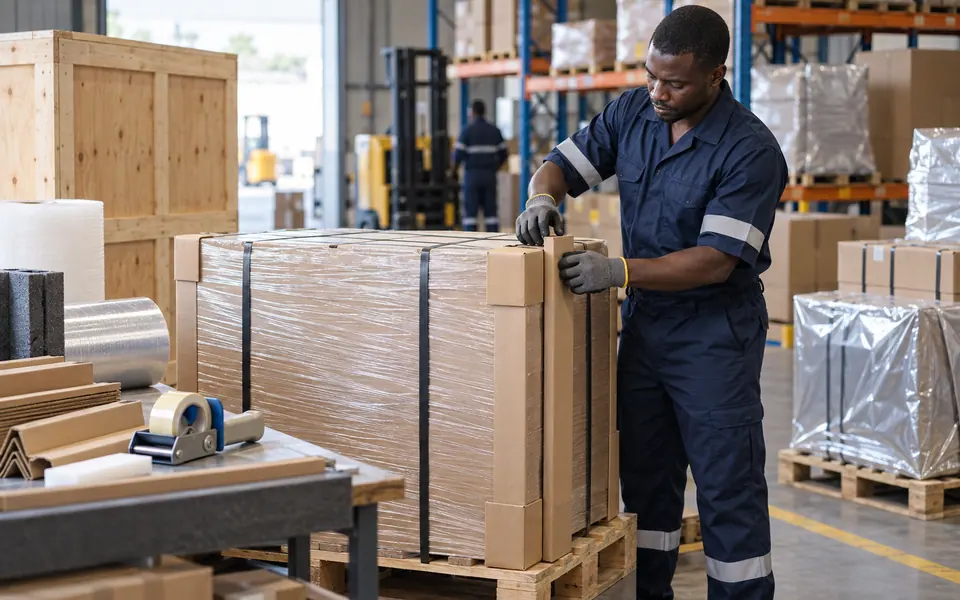
Every year, cargo arrives at ports and airports damaged, delayed or rejected, not because the freight itself was mishandled, but because it was packed for the wrong journey. Air freight and sea freight put very different stresses on a shipment. This guide explains how to package goods correctly, whether you are sending a 20 kg parcel of electronics by air or a full container of machinery by sea.
Air freight and sea freight are different journeys
Air freight is a game of weight and space. Cargo moves fast, but it is handled repeatedly across conveyors, loaders and aircraft holds. It can also experience pressure and temperature changes at altitude. Airlines charge using chargeable weight, which is whichever is greater: the actual weight or the volumetric weight.
Volumetric weight in kilograms = length × width × height in centimetres ÷ 6,000.
A large, lightweight box can therefore cost more to fly than a small, dense box of the same actual weight. Air freight packaging should fit the product closely because empty space can become billable space.
Sea freight is a game of time and moisture. A shipment on the water for several weeks can face humidity, condensation, salt air and repeated stacking in a container yard. The priorities are moisture resistance, corrosion protection and load stability over the long haul.
Packaging principles by freight mode
For air freight
- Right-size everything. Match the box or crate to the product with minimal void space to keep volumetric weight under control.
- Go light but rigid. Double or triple-wall corrugated cardboard, moulded pulp and lightweight plastic crates protect cargo without adding unnecessary weight. Reserve wood and metal crates for genuinely fragile or high-value cargo.
- Cushion without adding bulk. Foam suspension and air cushioning can secure fragile items without the mass of dense filler.
- Label clearly and durably. Handling instructions and hazardous-goods markings must follow the applicable carrier and IATA requirements. Incorrect labels can delay or stop cargo.
For sea freight
- Build for the long haul. Reinforced cartons, wooden crates or metal-strapped pallets generally tolerate repeated handling and weeks in transit better than standard retail packaging.
- Seal against moisture. Use moisture-barrier bags, desiccant packs and shrink wrap for metal, electronic or organic goods that can corrode or mildew inside a humid container.
- Treat solid wood. Solid wooden pallets, crates and dunnage used in international sea freight generally need to be ISPM 15 compliant, heat-treated and marked with the official IPPC mark. Plywood, oriented strand board and plastic or metal pallets can offer alternatives where suitable.
- Load heavy to light. Place heavier goods at the bottom and lighter goods above them. Use dunnage, strapping or stretch wrap to prevent movement in transit.
Packaging by product type
Electronics and high-value items
Phones, laptops and appliances are often suited to air freight because their value is high relative to their weight. Use anti-static packaging, foam-lined inner cartons and a rigid outer box. For sea freight, add moisture-barrier bags and silica gel packs, and avoid direct contact with metal crate walls.
Textiles, apparel and leather goods
Poly bags inside cartons help protect against moisture and dust in either mode. For sea freight, fully seal the cartons because fabric can absorb humidity and arrive musty or mildewed after a long journey.
Machinery, equipment and heavy cargo
Heavy or bulky equipment is usually more practical by sea. Use properly braced crates with internal blocking to prevent movement, corrosion-inhibiting wrap on exposed metal parts, and clear centre-of-gravity and lifting-point markings for handlers.
Perishable and temperature-sensitive goods
Perishables are commonly moved by air for speed, using insulated or refrigerated packaging, gel packs or dry ice where permitted, and packaging rated to maintain the required temperature range. Sea freight usually requires a refrigerated container and careful cold-chain planning.
Liquids, chemicals and cosmetics
Use leak-proof primary containers, absorbent material and sealed secondary packaging. Sea freight also calls for outer cartons or drums able to withstand prolonged vibration and stacking. Confirm aerosols and any classified hazardous or restricted goods with the carrier before booking.
Furniture and large household goods
These goods are generally moved by sea because of their bulk. Corner protectors, edge guards and shrink wrap help prevent surface damage. Any solid-wood crating should meet the applicable treatment and marking requirements.
Match packaging to shipment size
- Small parcels and courier-style air shipments: minimise box dimensions to control volumetric weight, while using crush-resistant cartons.
- Less than container load Cargo Groupage: use self-supporting, clearly labelled packaging. Shared cargo can be handled at several consolidation points.
- Full Container Load: plan the load across the entire container. Palletise and secure cargo so it cannot shift during the voyage.
- Bulk or high-volume shipments: standardise carton and pallet sizes where possible to improve loading, space use and stacking stability.
The bottom line
There is no universal best packaging. There is only packaging suited to the product, mode and shipment size. Air freight rewards light, compact and clearly labelled packages. Sea freight rewards durability, moisture protection and compliant materials that can withstand a longer journey.
If you are unsure which mode fits your shipment or how to prepare it, Sunesis Connect can review the cargo, documentation and route requirements before the goods leave the warehouse.