
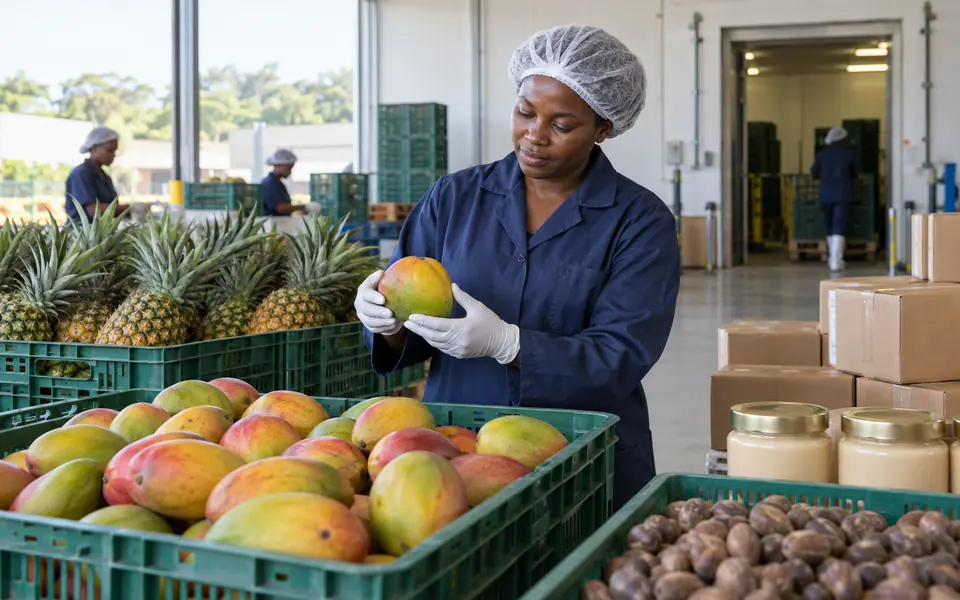
If you're growing or exporting perishable produce from Ghana, cold chain management isn't a nice-to-have layered on top of your export process; for fresh fruit and similar goods, it effectively is the export process. Here's what determines whether your shipment arrives sellable or spoiled.
Why does cold chain matter so much for Ghana's agricultural exports?
Ghana is one of Africa's significant exporters of cashew nuts and oil seeds, pineapples, mangoes, fresh or chilled tuna, and bananas; together forming a large share of the country's non-traditional agricultural export earnings. But fresh produce is fundamentally different from processed or dry goods: it starts losing quality the moment it's harvested, and every gap in temperature control; a hot truck, a delayed pack house, a warm holding shed; compounds that loss. Market analysis has put the potential revenue opportunity for cold chain and post-harvest loss management solutions in Ghana's fruit and vegetable sector at up to $900 million annually; which gives some sense of how much value is currently being lost to gaps in the chain.
What does a well-managed cold chain actually look like?
- Harvest to pack house, fast. Produce needs to reach a temperature-controlled pack house as quickly as possible after harvest; delays here are where much of the avoidable quality loss happens.
- Pack house processing and pre-cooling. Ghana's key horticultural districts now have temperature-controlled pack houses that sort, grade, and pre-cool produce before it moves toward the port or airport; a significant improvement over conditions a couple of decades ago.
- Cold-chain transport to the export gateway. Whether by refrigerated truck to Tema or direct to Kotoka International Airport, temperature control needs to hold continuously; a single uncooled leg of the journey can undo everything done correctly up to that point.
- Export-side facilities. Tema Harbour's dedicated Fruit Terminal (Shed 9) is a purpose-built temperature-controlled facility with multiple independent temperature chambers and meaningful weekly throughput capacity for perishable goods moving onto outbound vessels; a substantial upgrade from the single, poorly-controlled storehouse it replaced.
- The final transit leg itself. Air freight moves fast but needs consistent cold-chain handling at the airport and in the aircraft hold; sea freight in reefer containers holds temperature for the full multi-week voyage but only if the container is functioning correctly and the produce was properly pre-cooled before loading.
Air freight or sea freight for perishable exports; which fits your product?
- Air freight suits genuinely time-sensitive, high-value perishables where a few days can make the difference between fresh arrival and spoilage; certain fruits, and any product where the buyer needs it landing within a tight window. It's more expensive, but for the right product, that cost is the price of the product actually being sellable on arrival.
- Sea freight in reefer containers is far more economical for larger volumes and suits produce that holds up over a longer, properly refrigerated voyage; pineapples and similar goods are commonly shipped this way, provided pre-cooling and container temperature control are managed correctly from the start.
The right choice generally comes down to your specific product's shelf life once properly cooled, your order volume, and how time-sensitive your buyer's market actually is.
What are the biggest risks to Ghana's perishable export cold chain today?
- Rural infrastructure gaps; inconsistent road quality and transport time from farm to pack house remain a real constraint, particularly outside the most developed horticultural districts.
- Unreliable electricity supply; inconsistent power at pack houses and cold storage facilities forces reliance on generators, adding cost and risk of a cooling gap during any power interruption.
- Declining exporter numbers in some sub-sectors; Ghana's pineapple export sector, for example, has seen its number of active exporters fall sharply from a much larger base in the early 2000s, reflecting how challenging consistent, high-quality perishable export has been to sustain at scale.
- Airfreight capacity and reliability constraints across the West African region more broadly, which can affect how consistently perishable exporters can access cargo flights when they need them.
What should a new perishable exporter prioritise first?
Before scaling volume, get the fundamentals of your specific cold chain locked down: a reliable pack house relationship (your own or a shared facility) close enough to your growing area to minimise the harvest-to-cooling gap, a transport partner who won't break the cold chain between pack house and port or airport, and a clear-eyed view of your product's actual shelf life under correct refrigeration; which tells you honestly whether air or sea freight is the right call for your specific volumes and markets.